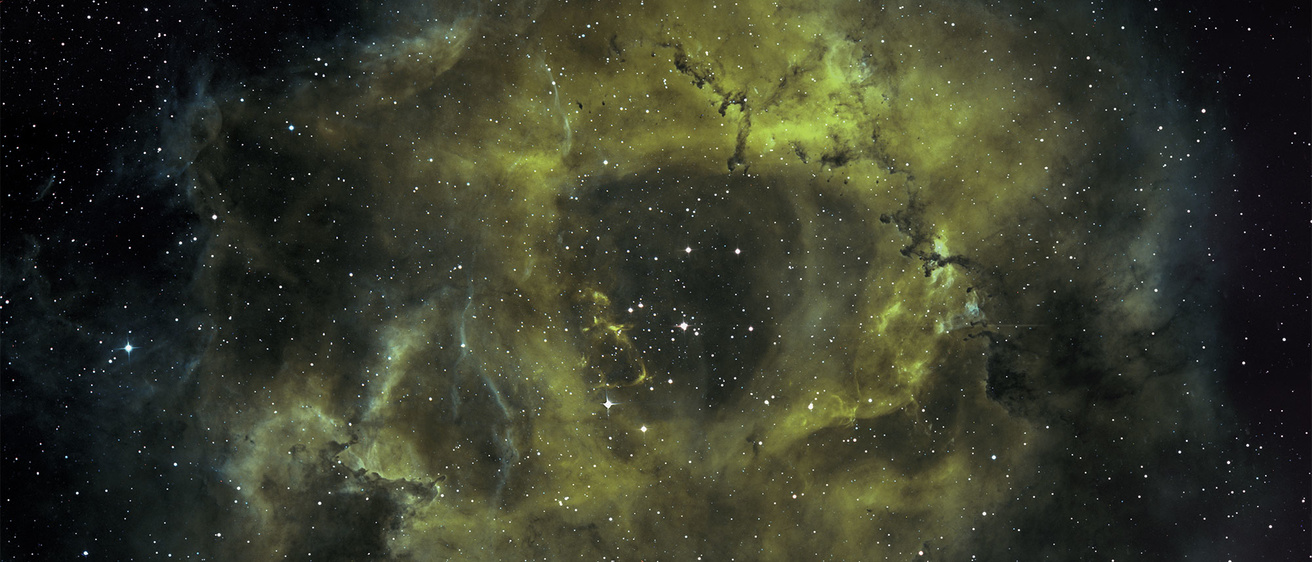
The Rosette Nebula (NGC 2247) is a vast molecular cloud region located 5,000 light years from Earth. This image was created by undergraduate student Chris Michael using images taken at the Van Allen Observatory’s Gemini telescope located in southern Arizona.
Astronomy and Astrophysics seeks to understand the composition, origin, evolution, and fate of the Universe as well as celestial bodies within in it. Observational studies use powerful telescopes on Earth and in space to observe comets, moons, planets, nebulae, stars, black holes, galaxies, and the interstellar medium. Emission from these objects is recorded across the electromagnetic spectrum, including x-ray, visible, infrared, and radio. Theories to explain observations draw on a wide range of subdisciplines, including classical mechanics, nuclear and statistical physics, electromagnetism, chemistry, biology, geology, and many others. Astronomy and Astrophysics seeks to understand how the universe works, how we got here, and whether we are alone.
Faculty in our department are deeply involved in construction of astronomical instruments and the analysis of the observations they make. Our department specializes in: studies of X-ray/ultraviolent gratings and detectors for proposed NASA missions; building and flying instruments aboard sounding rockets, CubeSats, Explorers, and beyond; and the use of large observational instruments such as ALMA, the VLA, and the Keck telescopes. Observationally, they are involved in the search for dark matter and unaccounted for baryonic matter and investigate such topics as star formation in the hot galactic center and cool interstellar clouds; galaxy formation, evolution, and interaction; plasma turbulence in the solar corona, solar wind, and interstellar medium; and black holes in the early universe. They have strong collaborations with faculty in the Plasma Physics and Space Physics research areas.
Students in this research area can obtain a physics Ph.D. following the astronomy track. We provide specialty courses on a wide range of astronomy/astrophysical topics, including extragalactic astronomy, the interstellar medium, stellar astrophysics, radiative processes in astrophysics, high energy astrophysics, space and astrophysical plasma physics, and general relativity. A regular astronomy and astrophysics seminar is held.
Observatories
Atacama Large Millimeter Array
ALMA, an NSF-funded array of radio telescopes working at mm/sub-mm wavelengths
Jansky Very Large Array
JVLA, a NSF-funded, ground-based array of radio telescopes
W. M. Keck Observatory
A ground-based set of 10m diameter telescopes working in the optical and near-IR
Gemini Observatory
A NSF-funded twin pair of telescopes placed in each hemisphere that observe in the optical/near-IR
Sloan Digital Sky Survey
SDSS, a set of optical telescopes/spectrographs used to take observations of over 1/3 of the sky
Hubble Space Telescope
NASA’s flagship optical/UV observatory
Chandra X-ray Observatory
NASA’s flagship X-ray observatory
HaloSat
NASA CubeSat designed, built, and operated by the University of Iowa designed to survey the Milky Way’s hot X-ray halo
XMM-Newton Observatory
X-ray Multi-Mirror Mission, ESA’s flagship X-ray observatory
News

Physics and astronomy student discovers endless possibilities at Iowa
Iowa astrophysicist part of team making breakthrough white dwarf discovery
DeRoo Receives Iowa Mid-Career Faculty Scholar Award
Swarm Receives Award from NASA

UI researcher helps NASA capture first X-ray of a white dwarf star
McShan receives ISGC grant for “Calibrating RR Lyrae Stellar Parameters" project

Silva receives ISGC grant to study ages of subgiant stars

Gayley discusses Martian rock that sold for $5 million at auction

Nataf Awarded Grants for Exoplanet Research
Payne wins grant to develop new telescope to better navigate solar system
Astronomy and Astrophysics faculty
Gregory G. Howes, PhD

Casey DeRoo, PhD

Hai Fu, PhD

Kenneth G. Gayley, PhD

Jasper S. Halekas, PhD

Cornelia C. Lang, PhD

David Nataf, PhD

Dustin Swarm, PhD