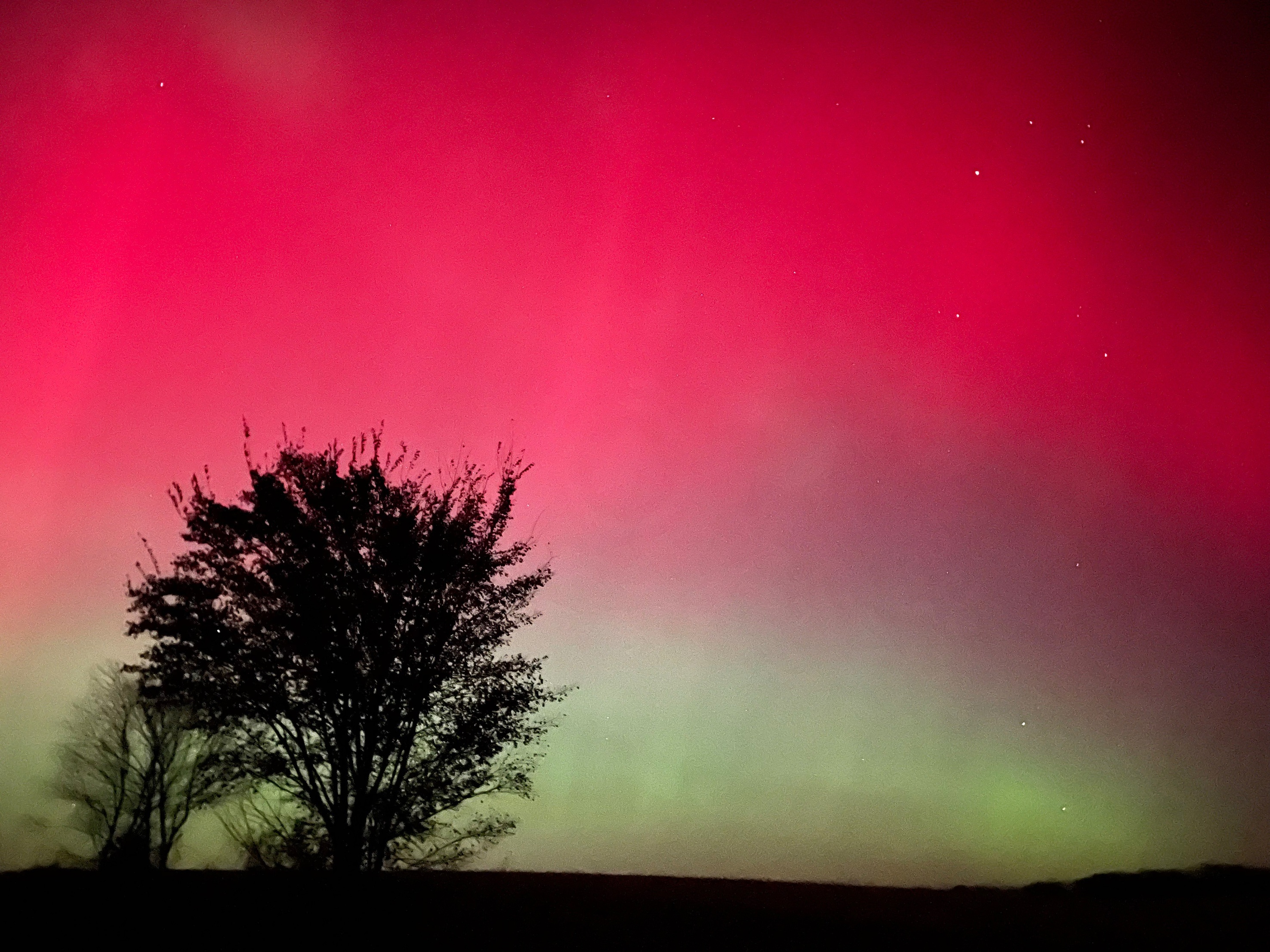
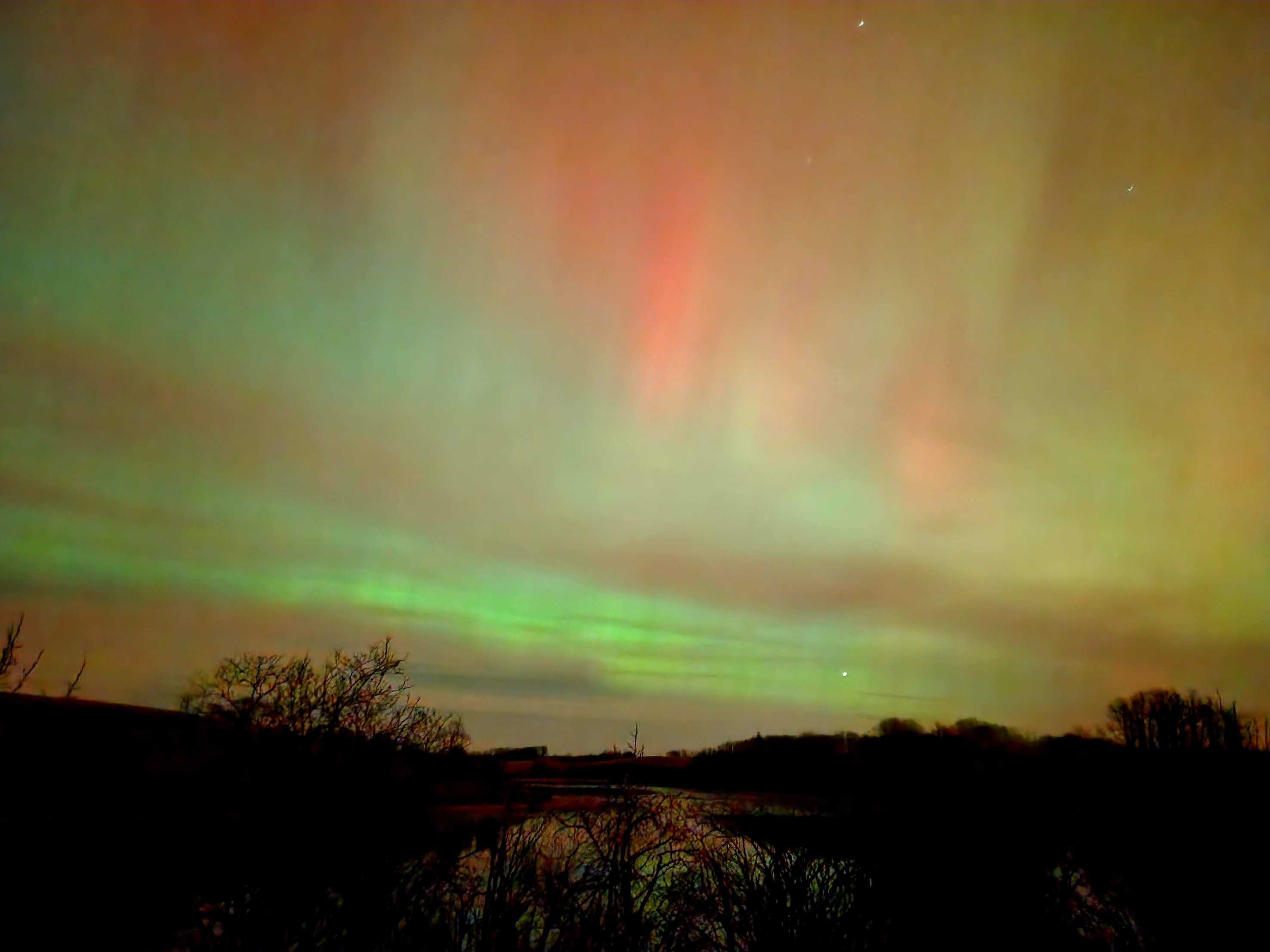
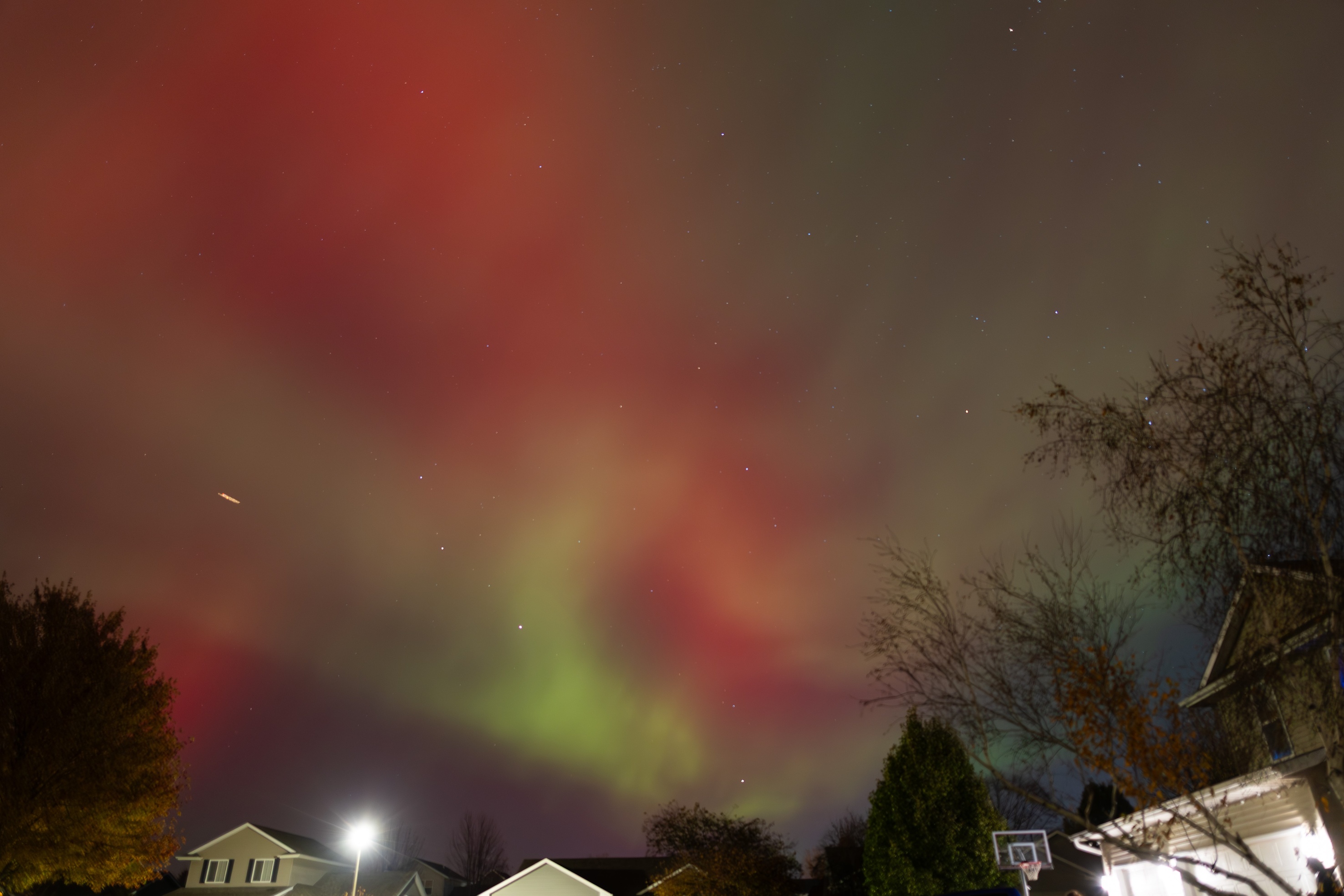
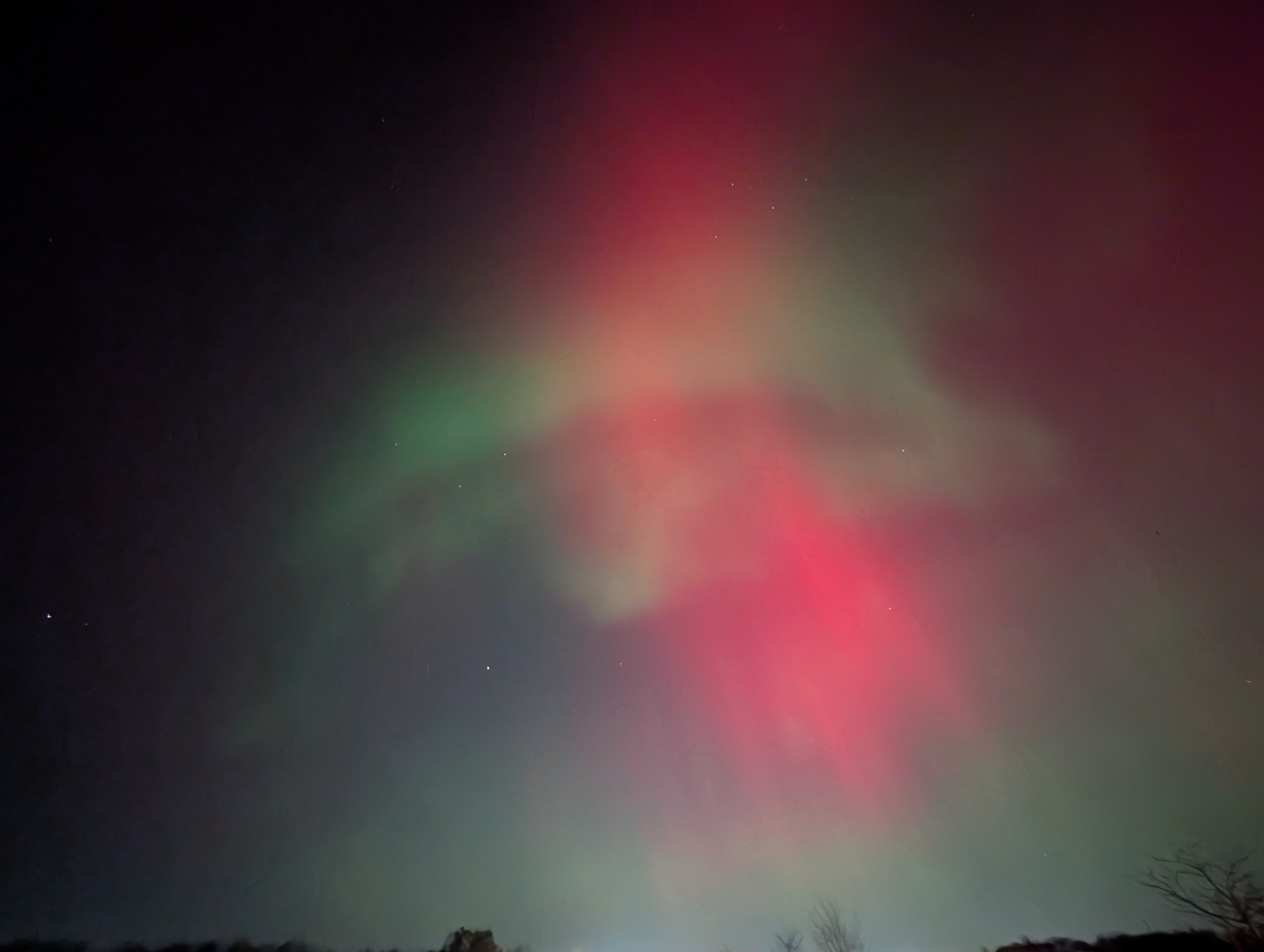
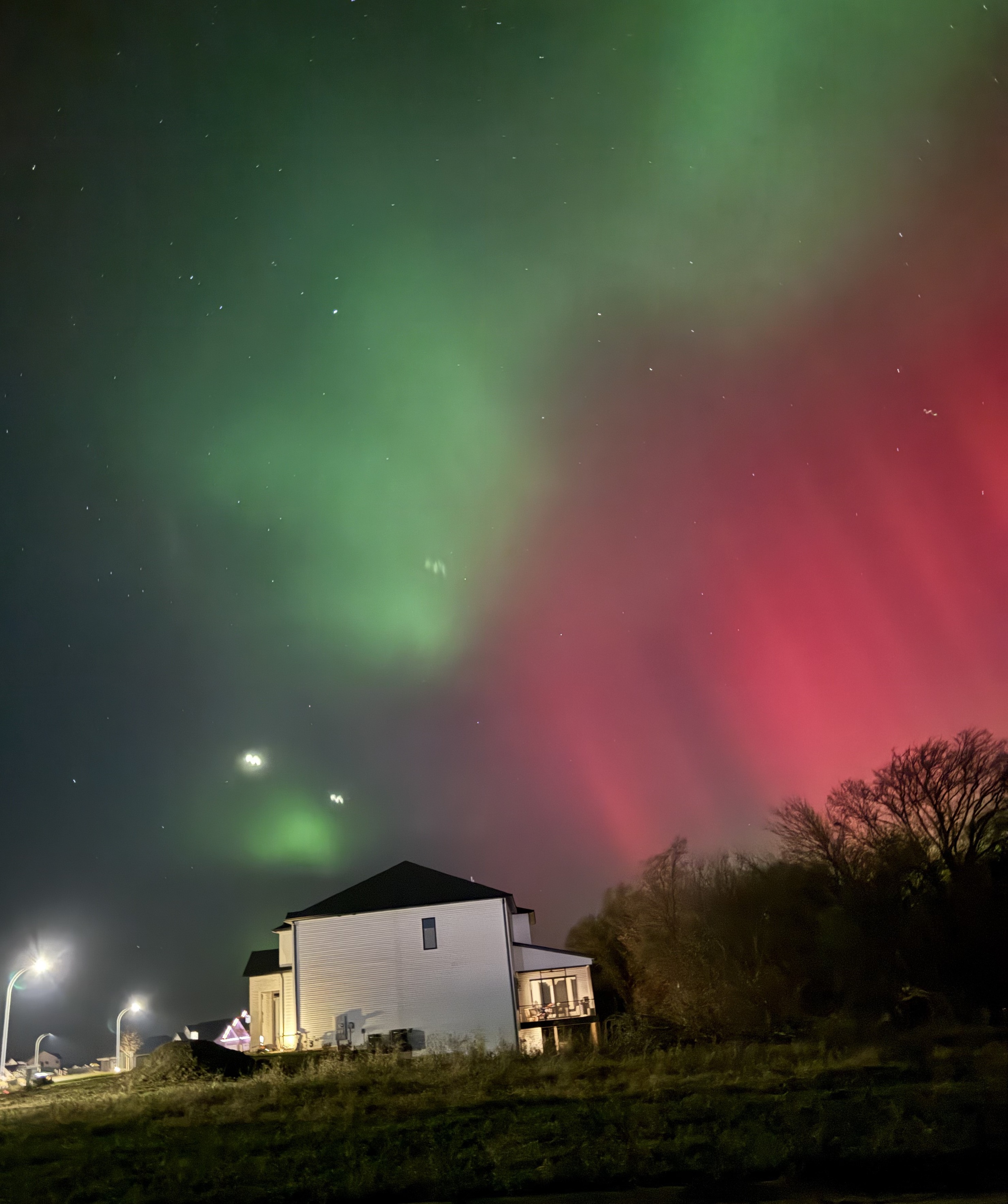
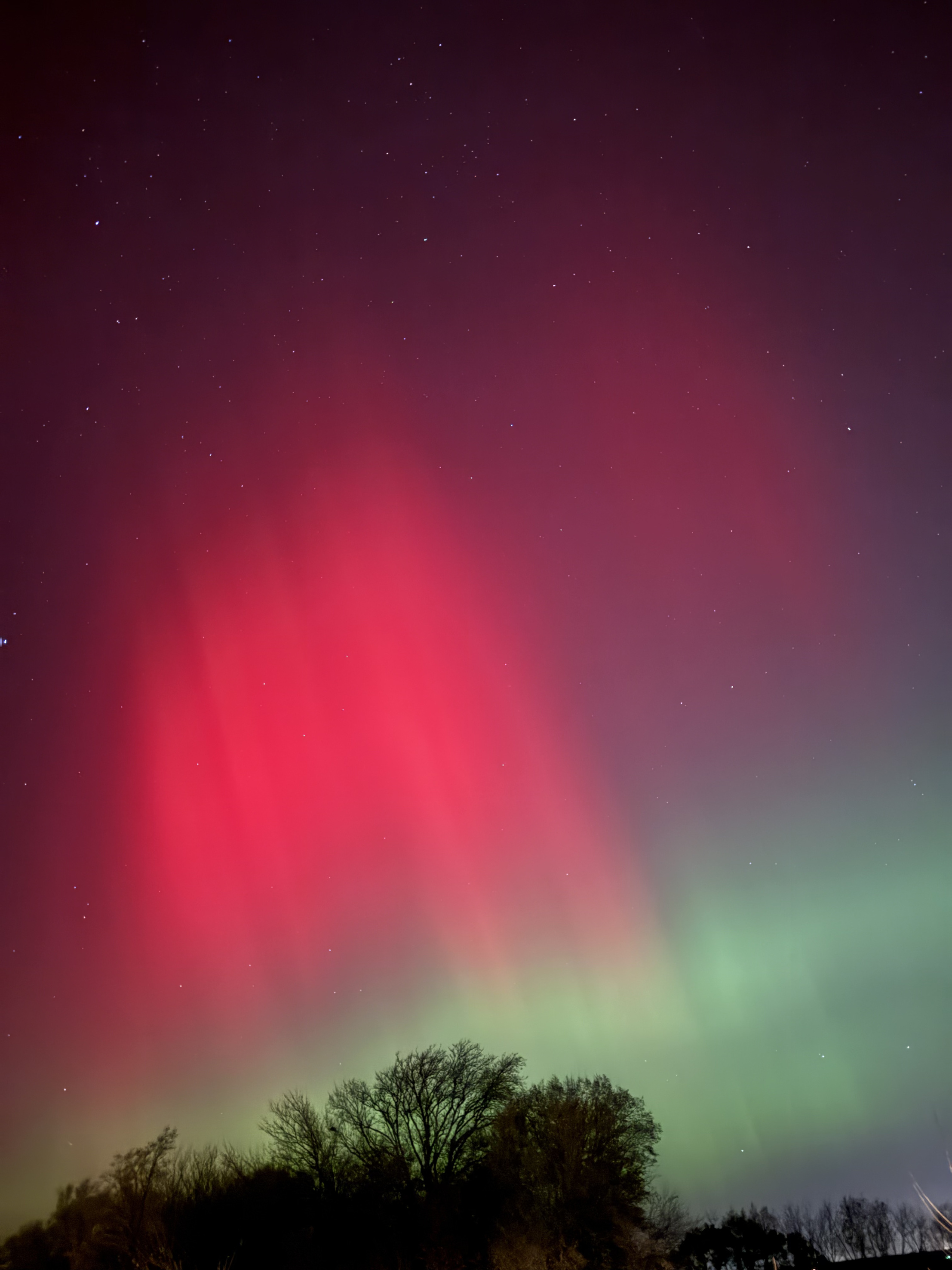
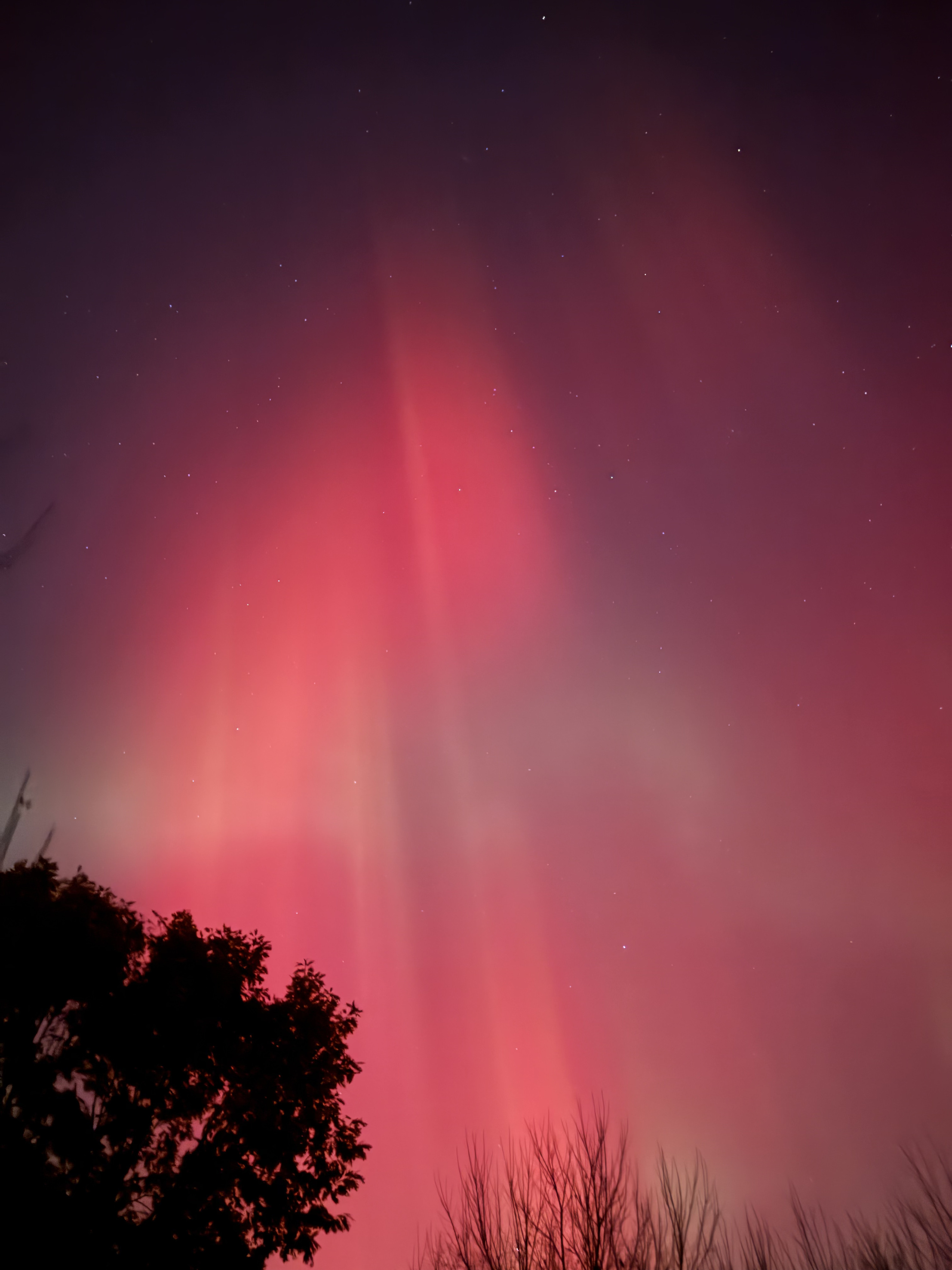
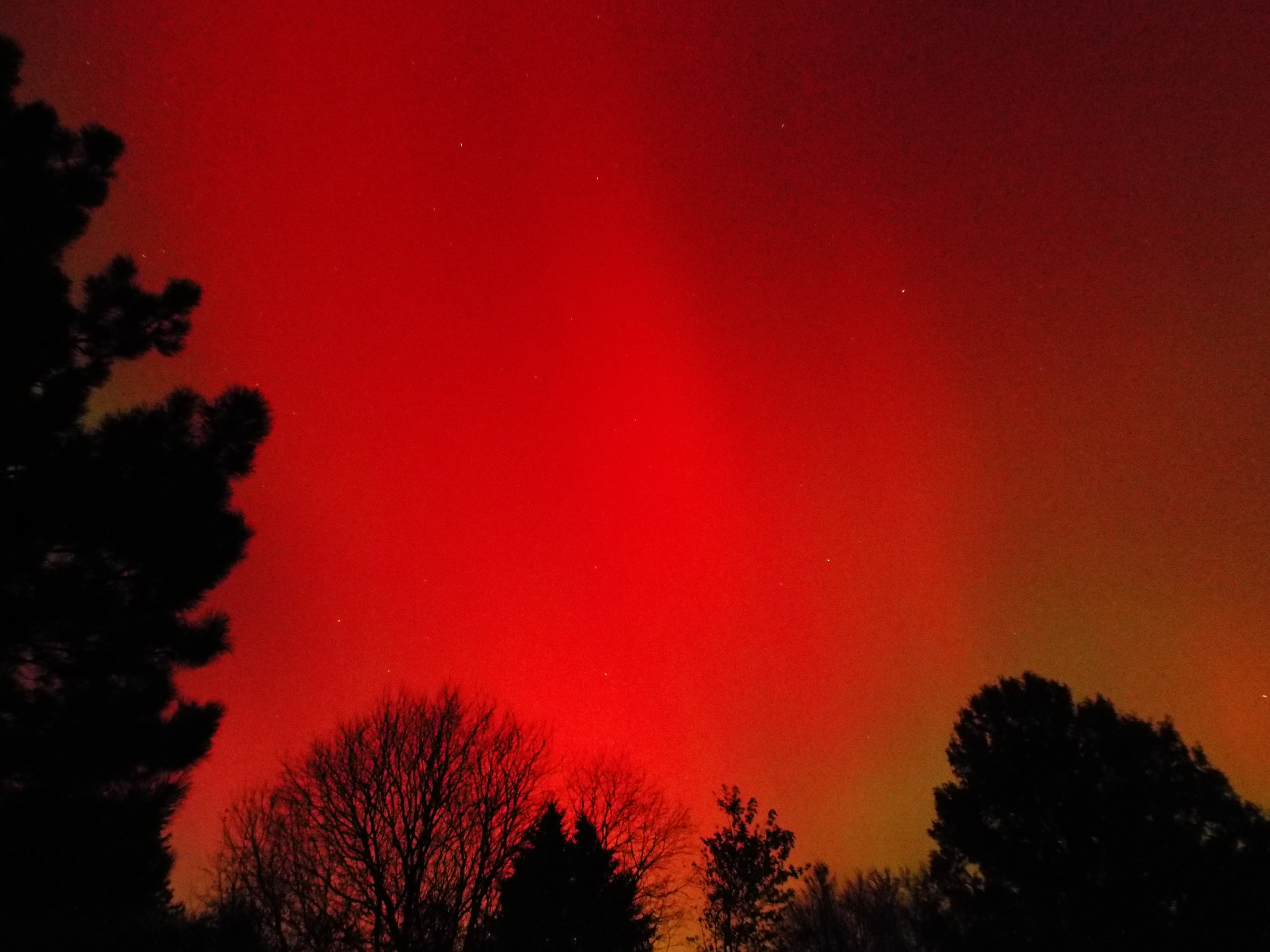
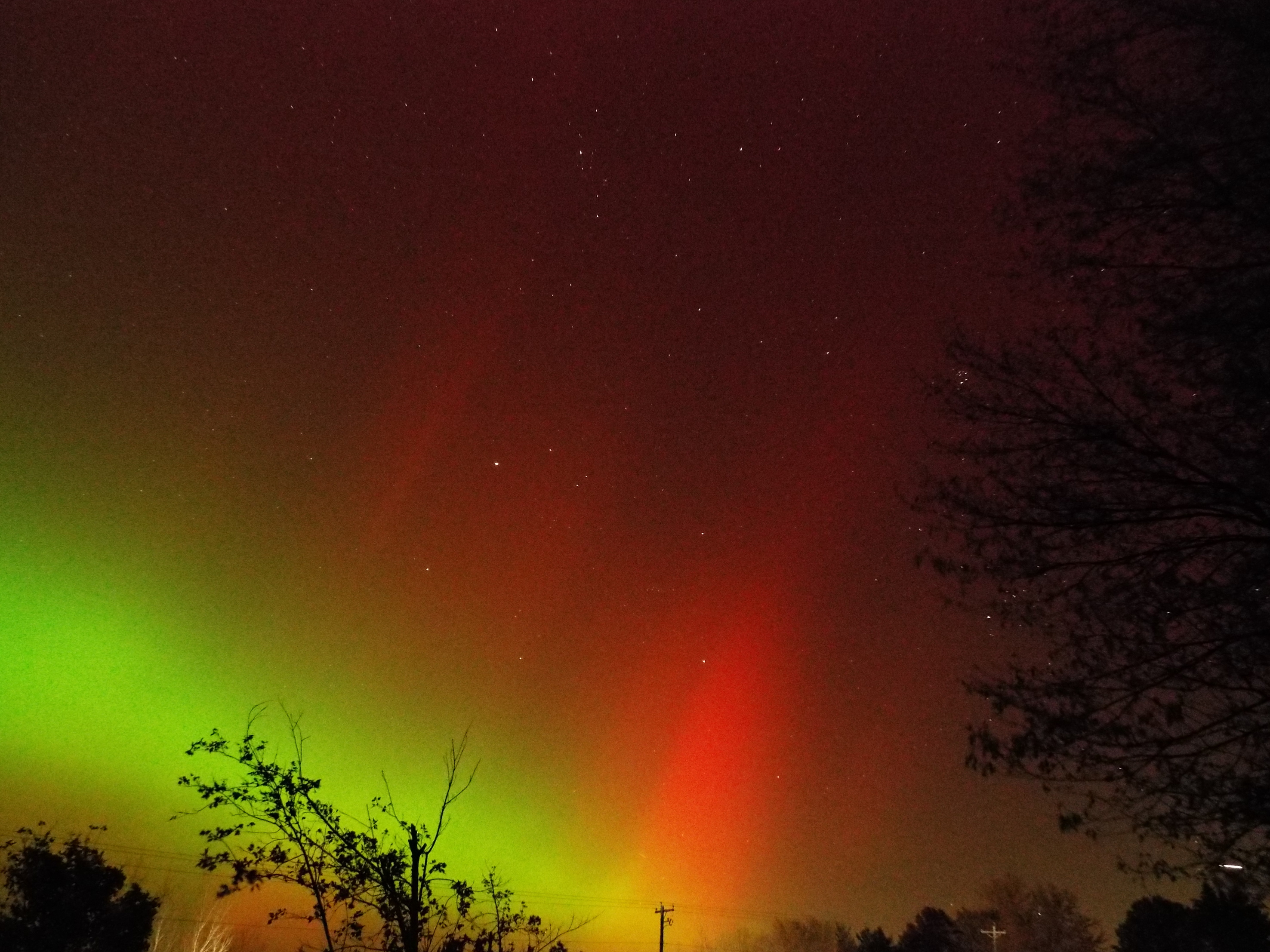
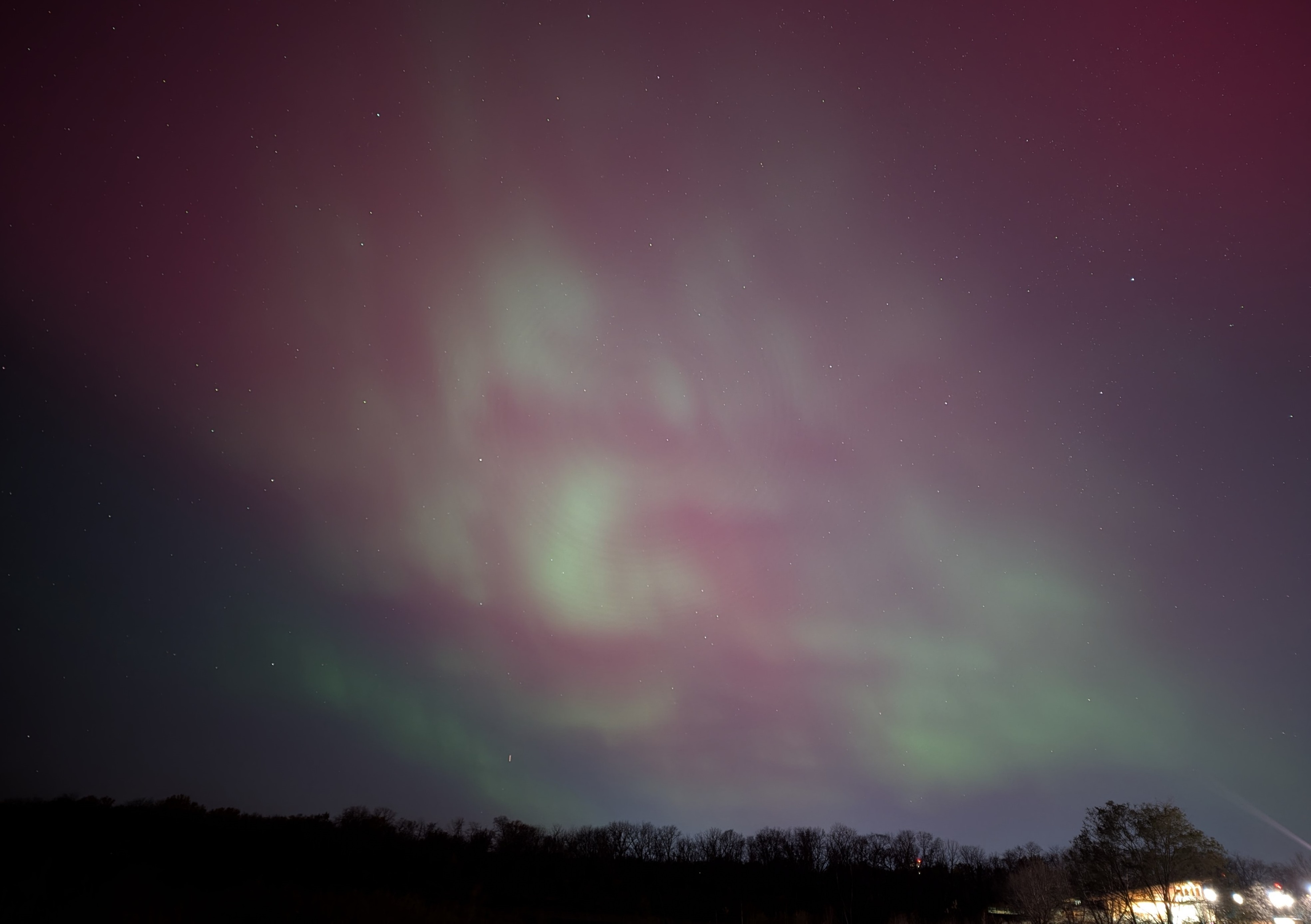
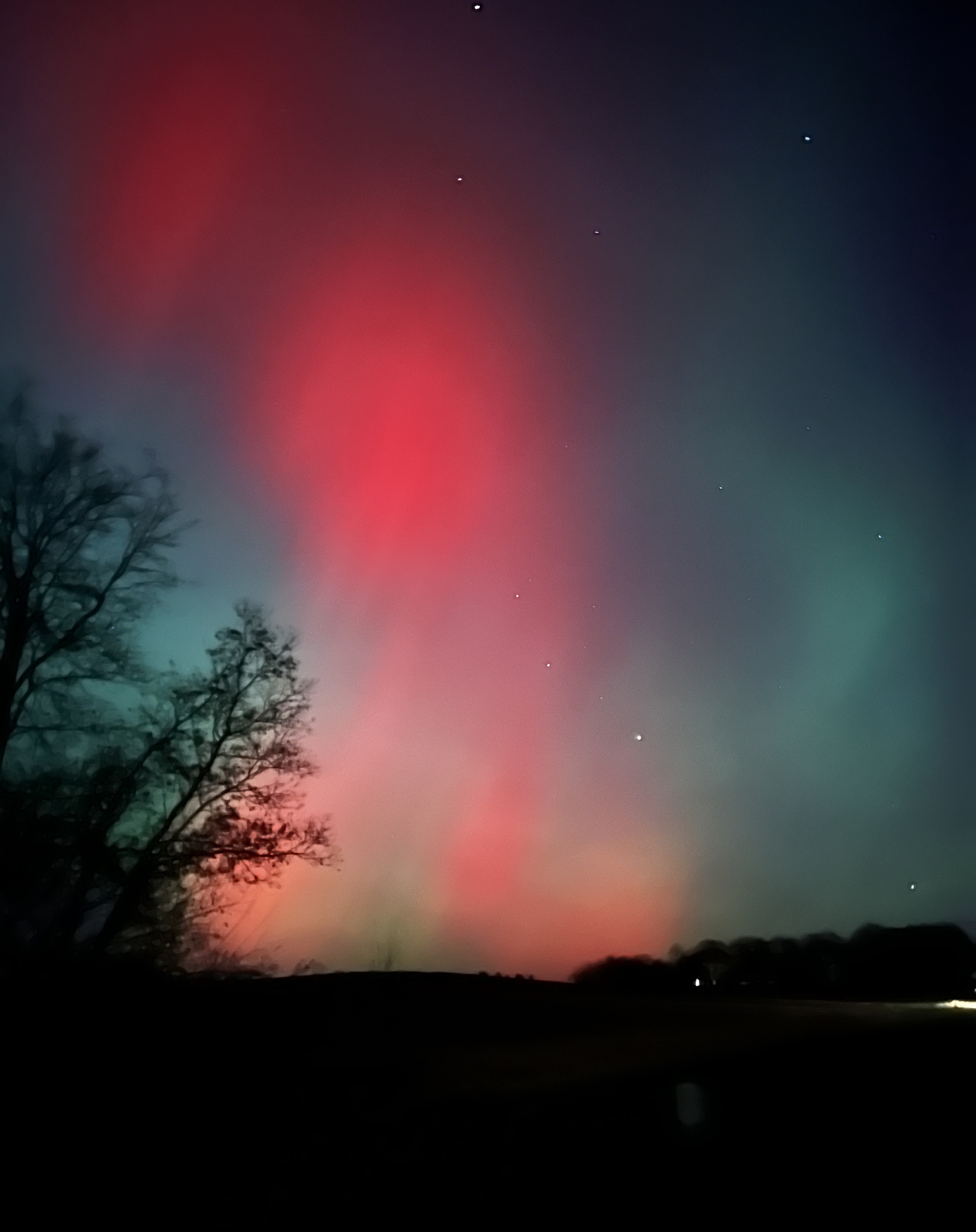
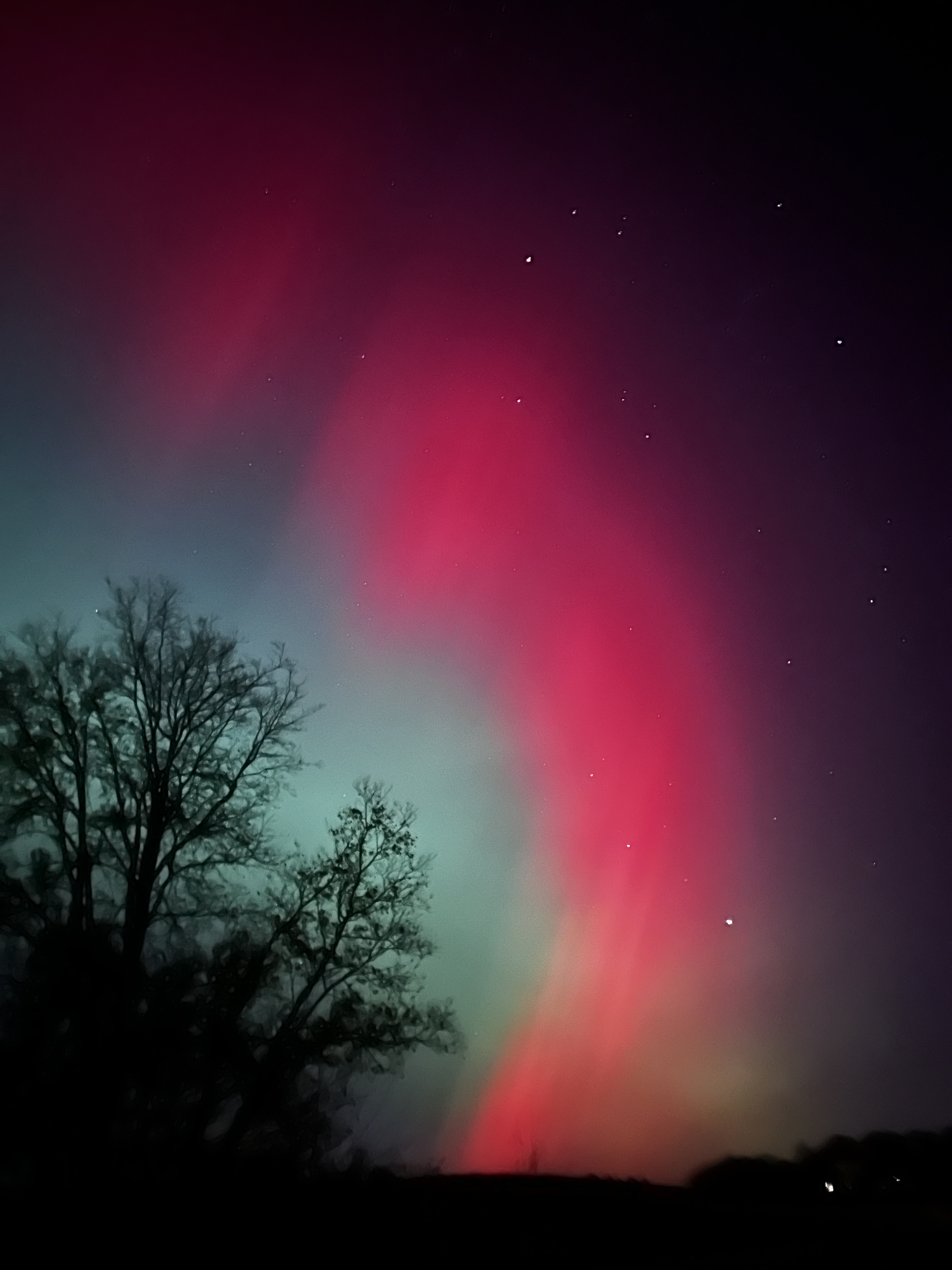
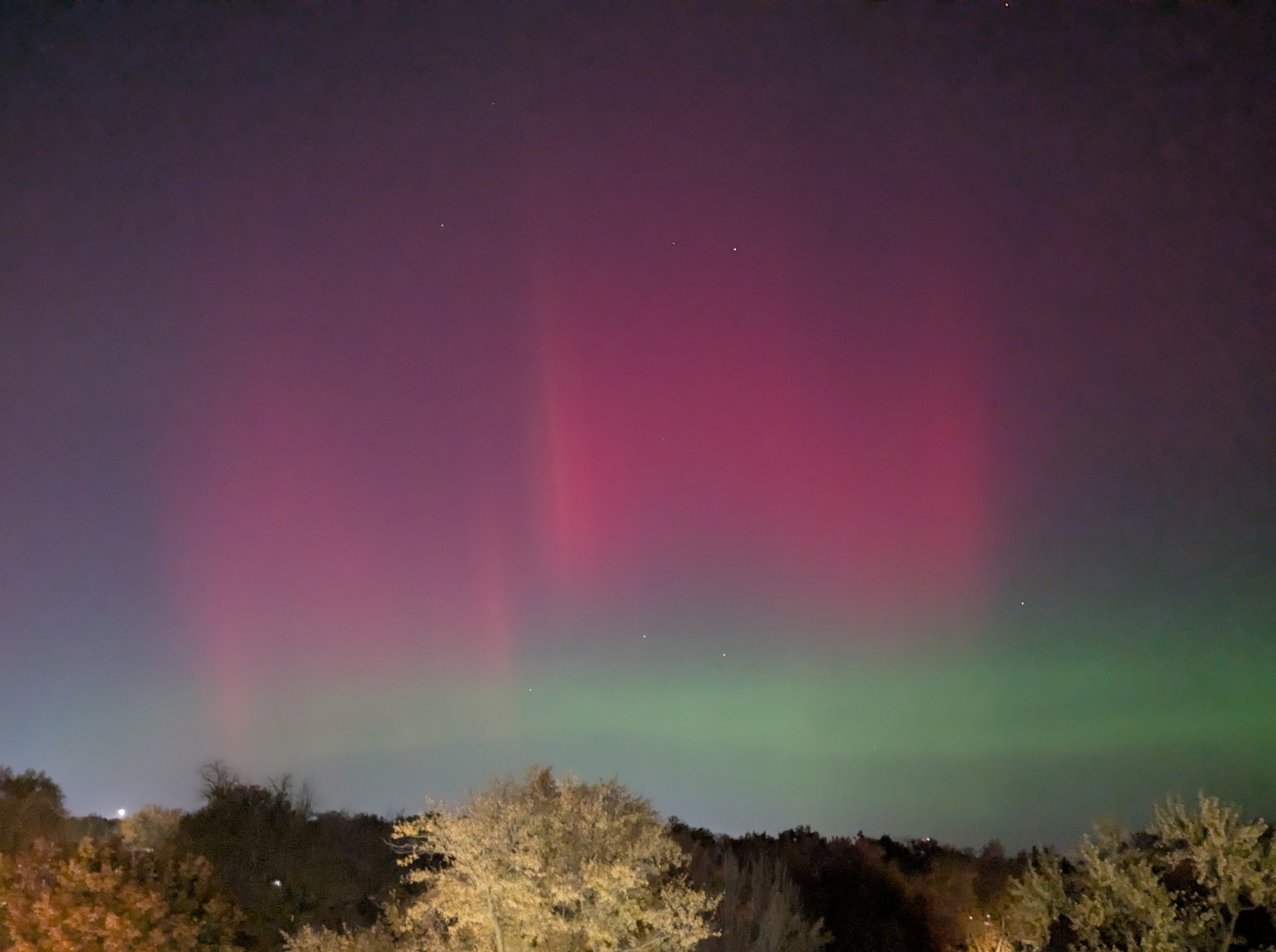
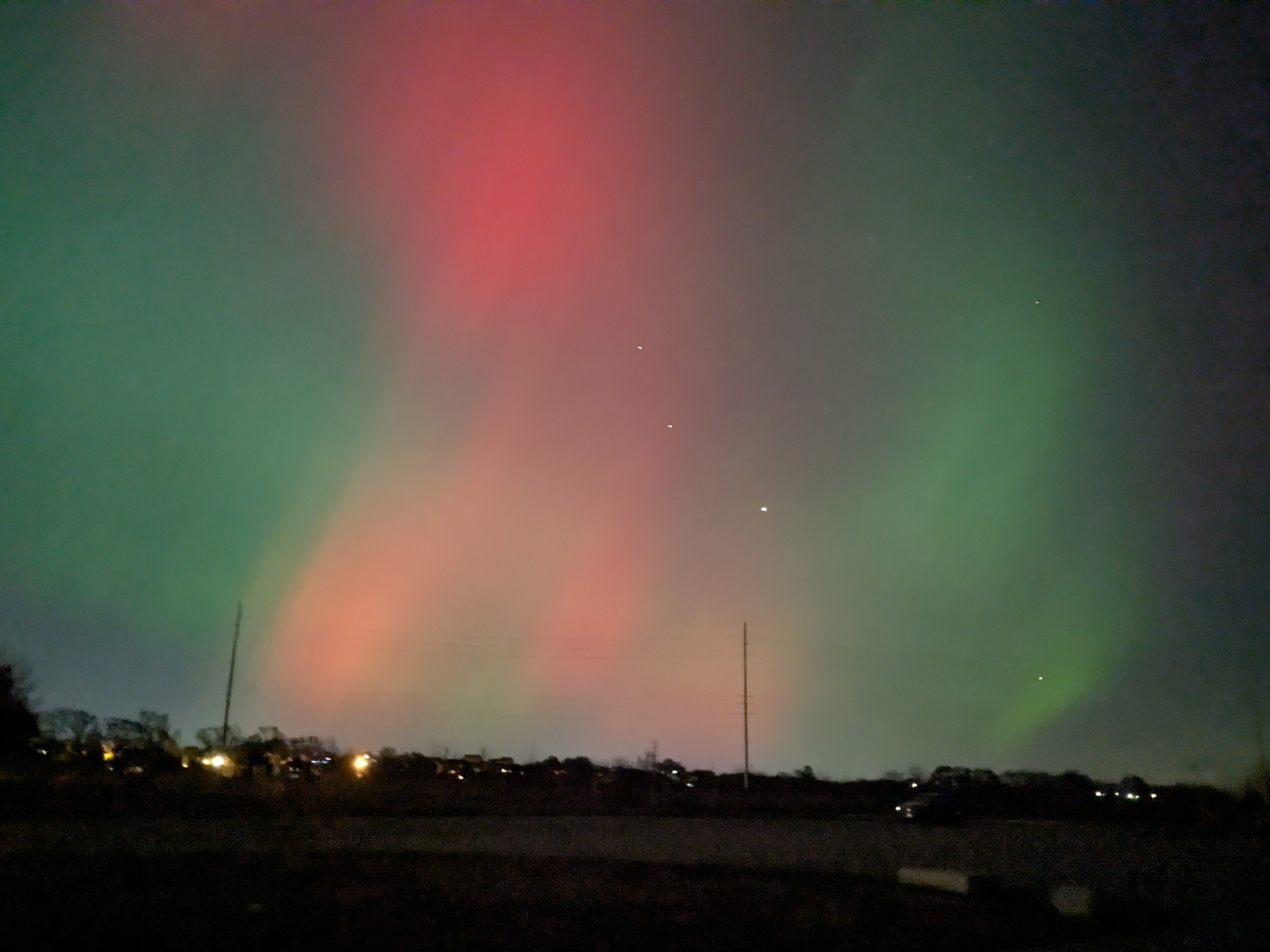
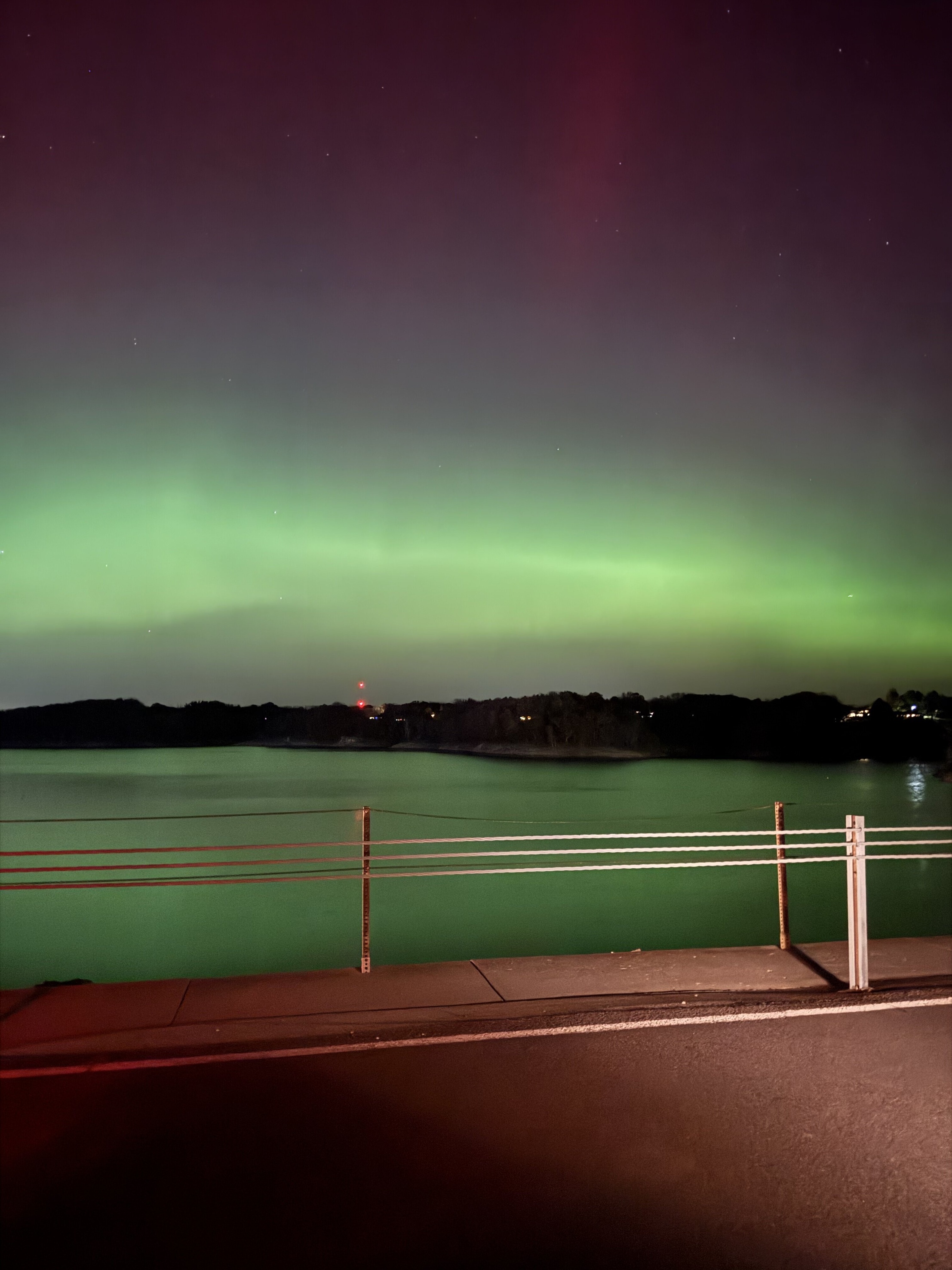
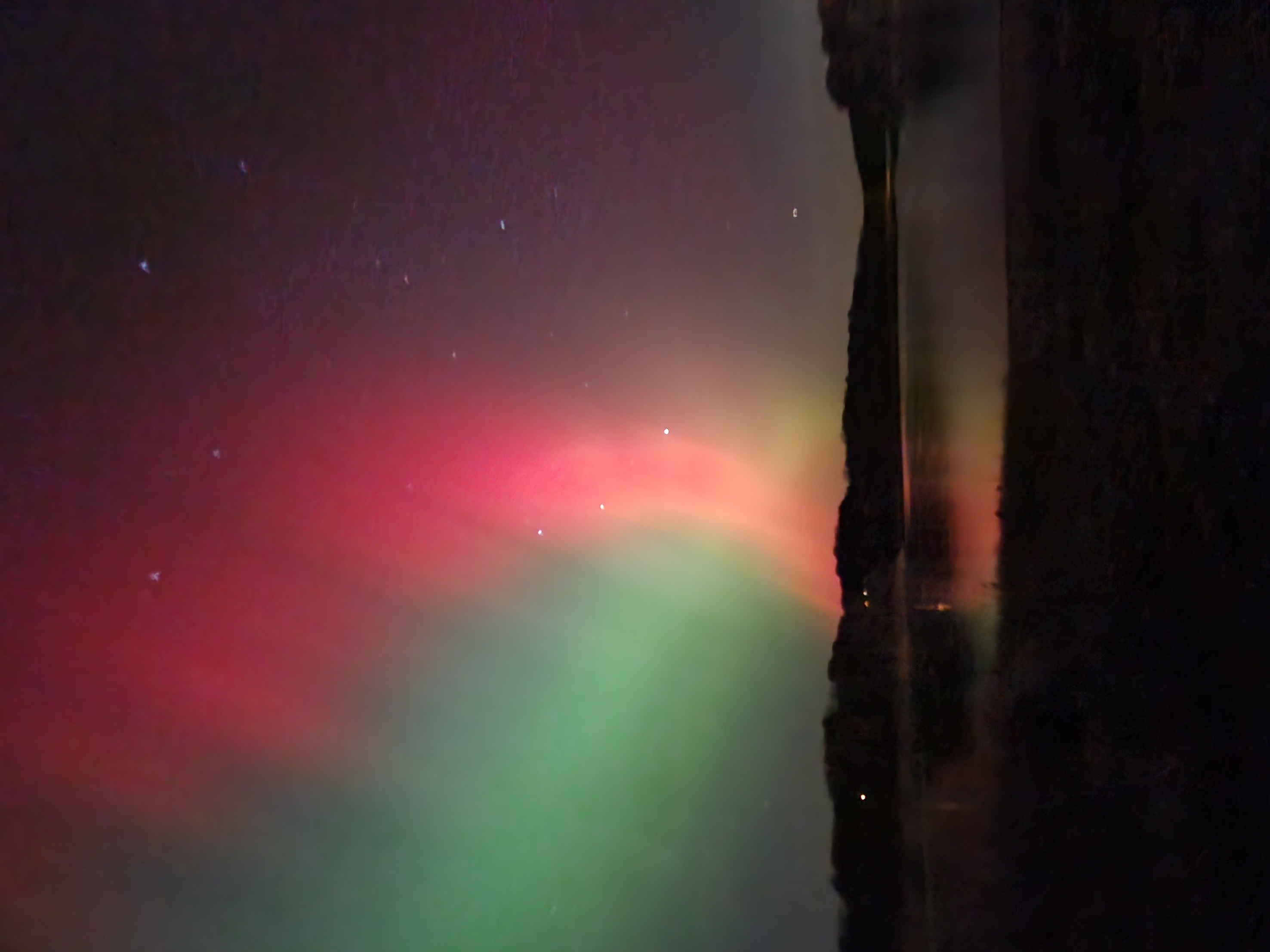
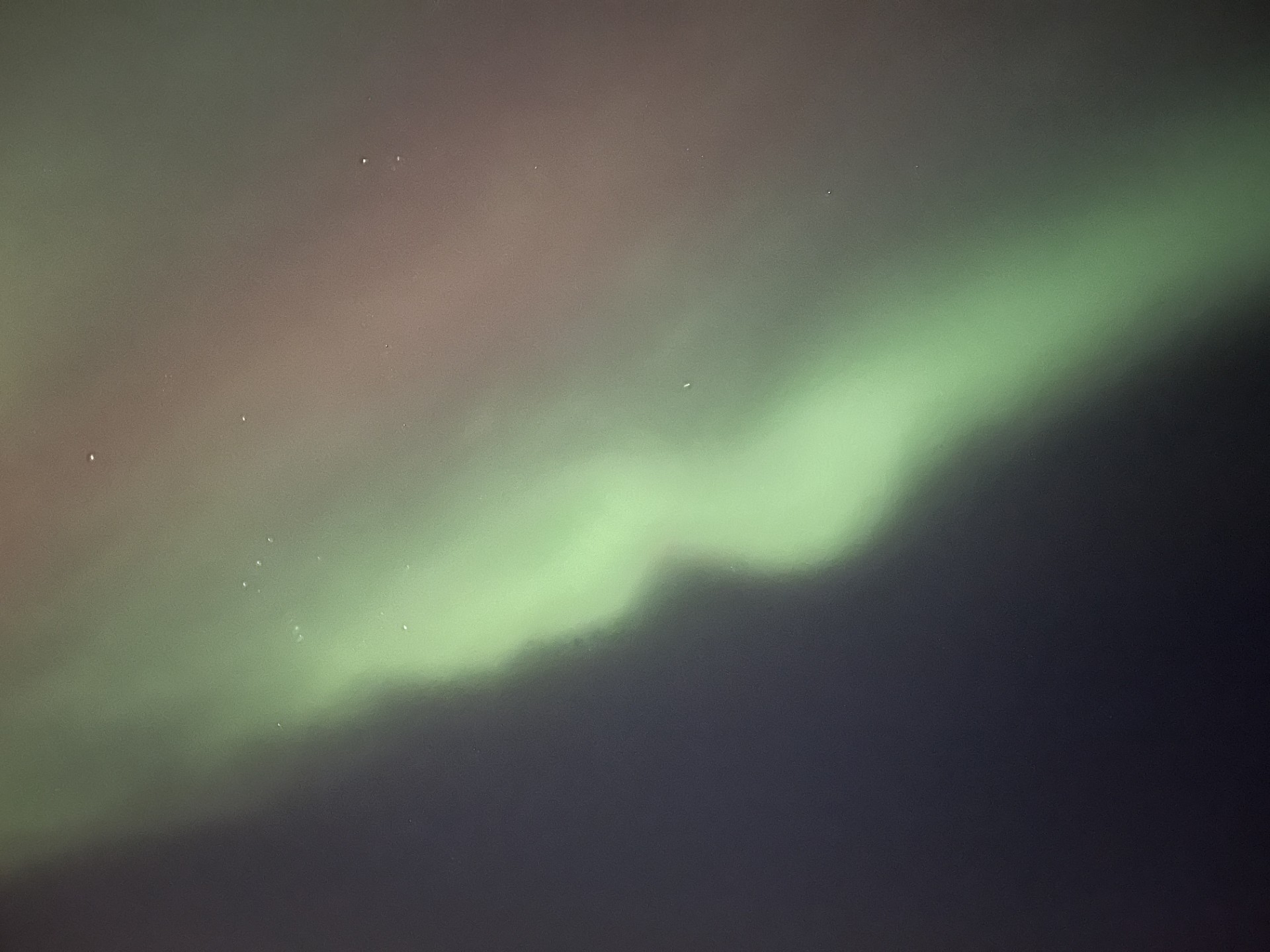
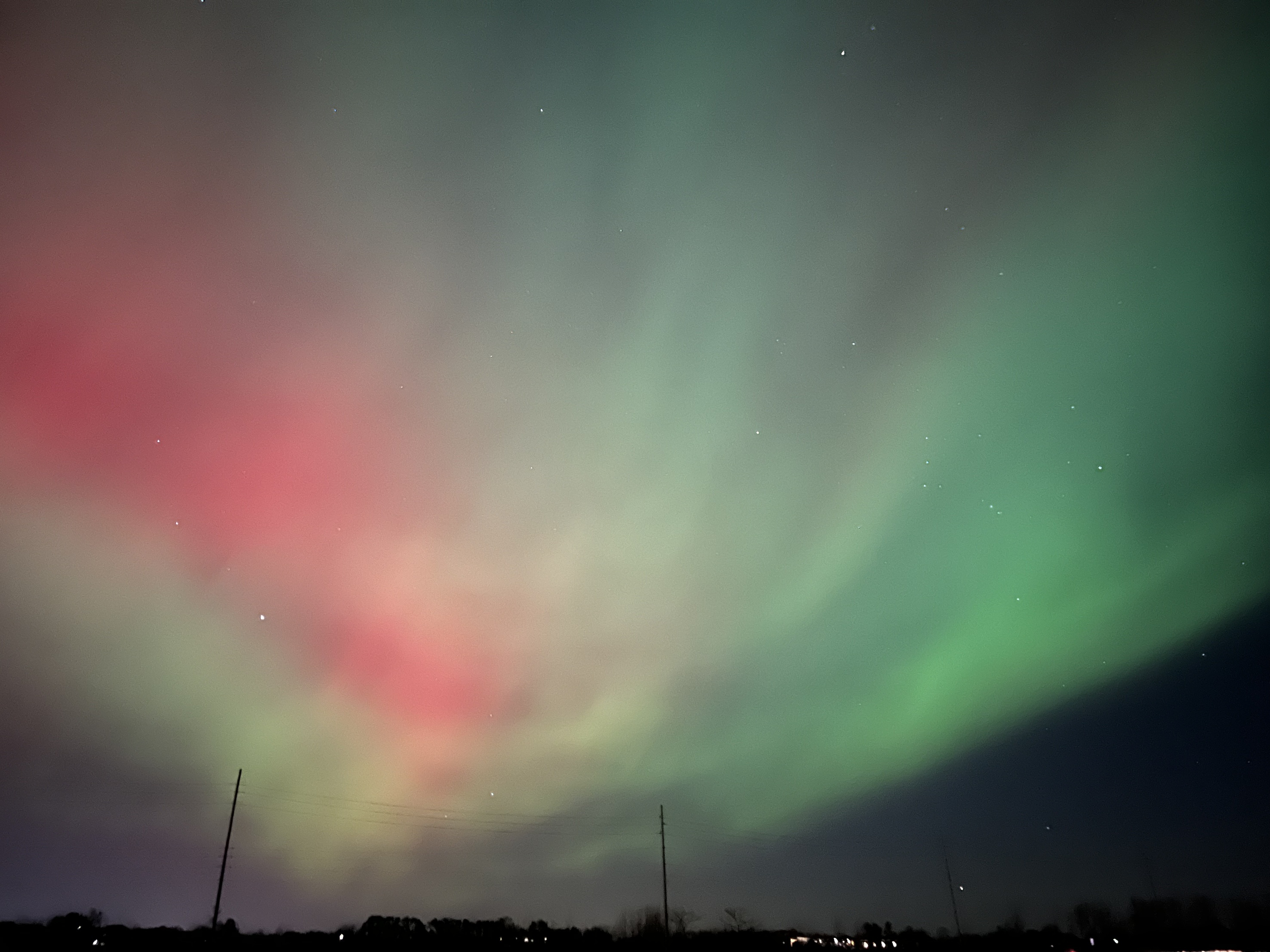
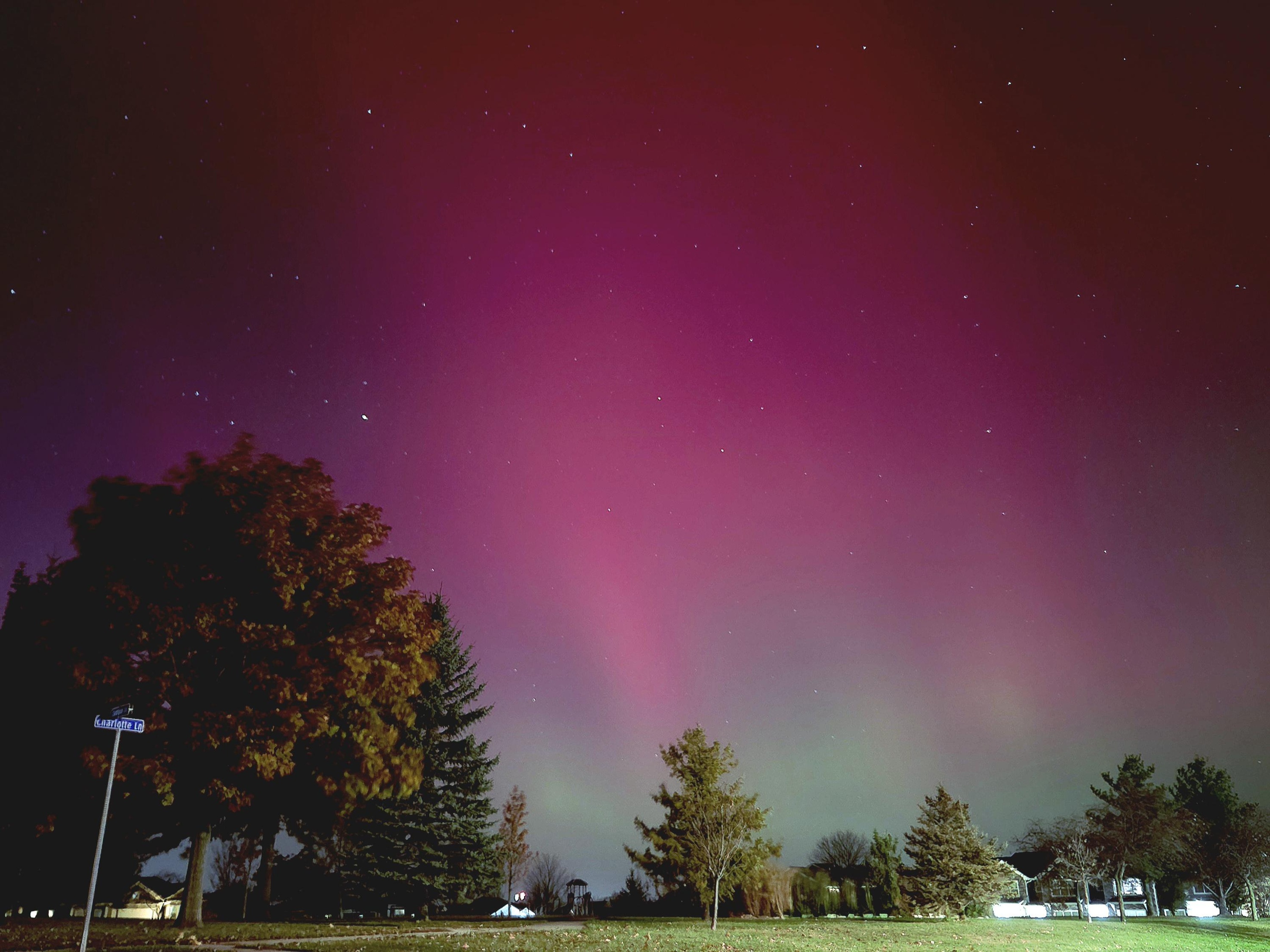
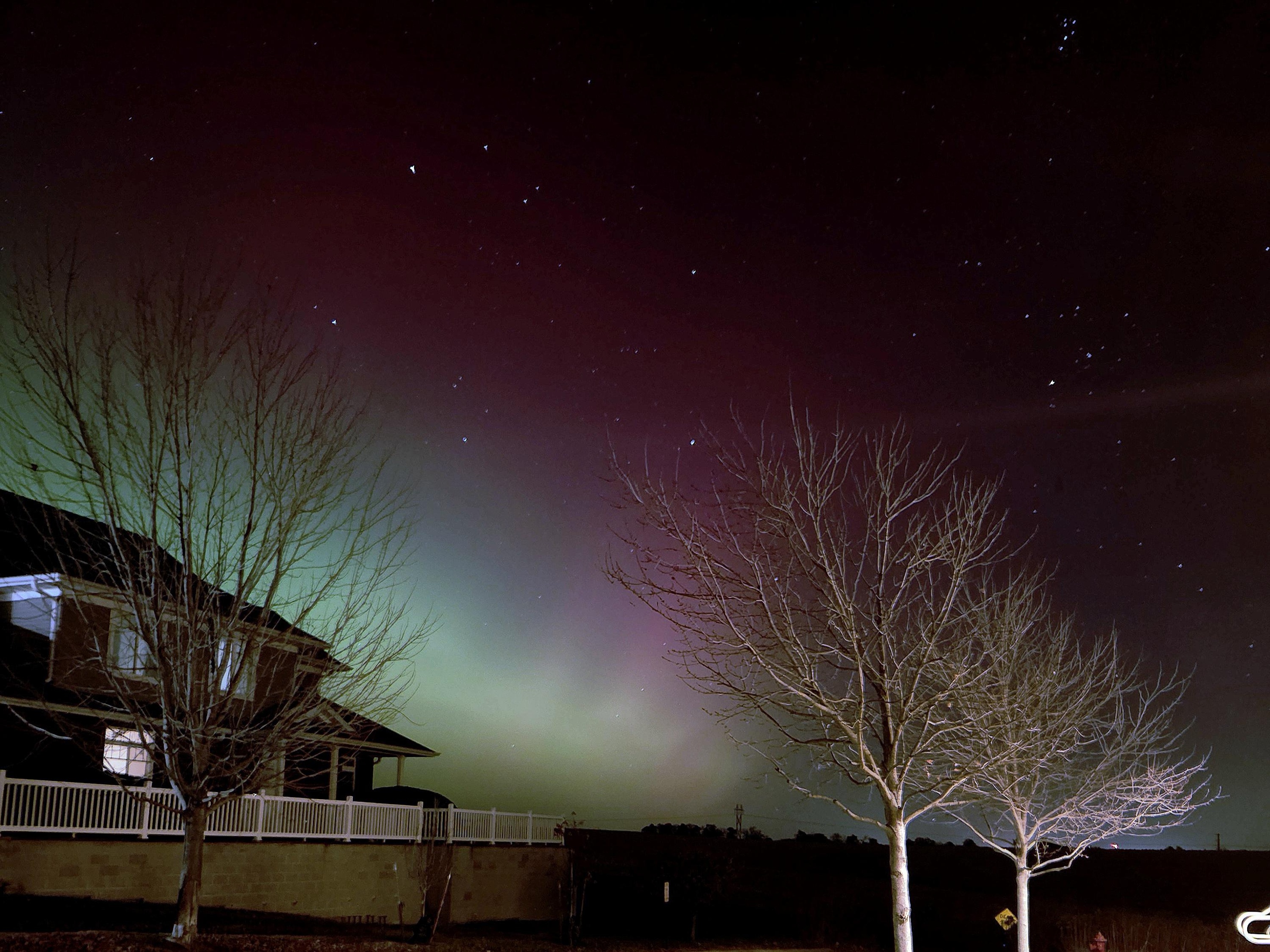
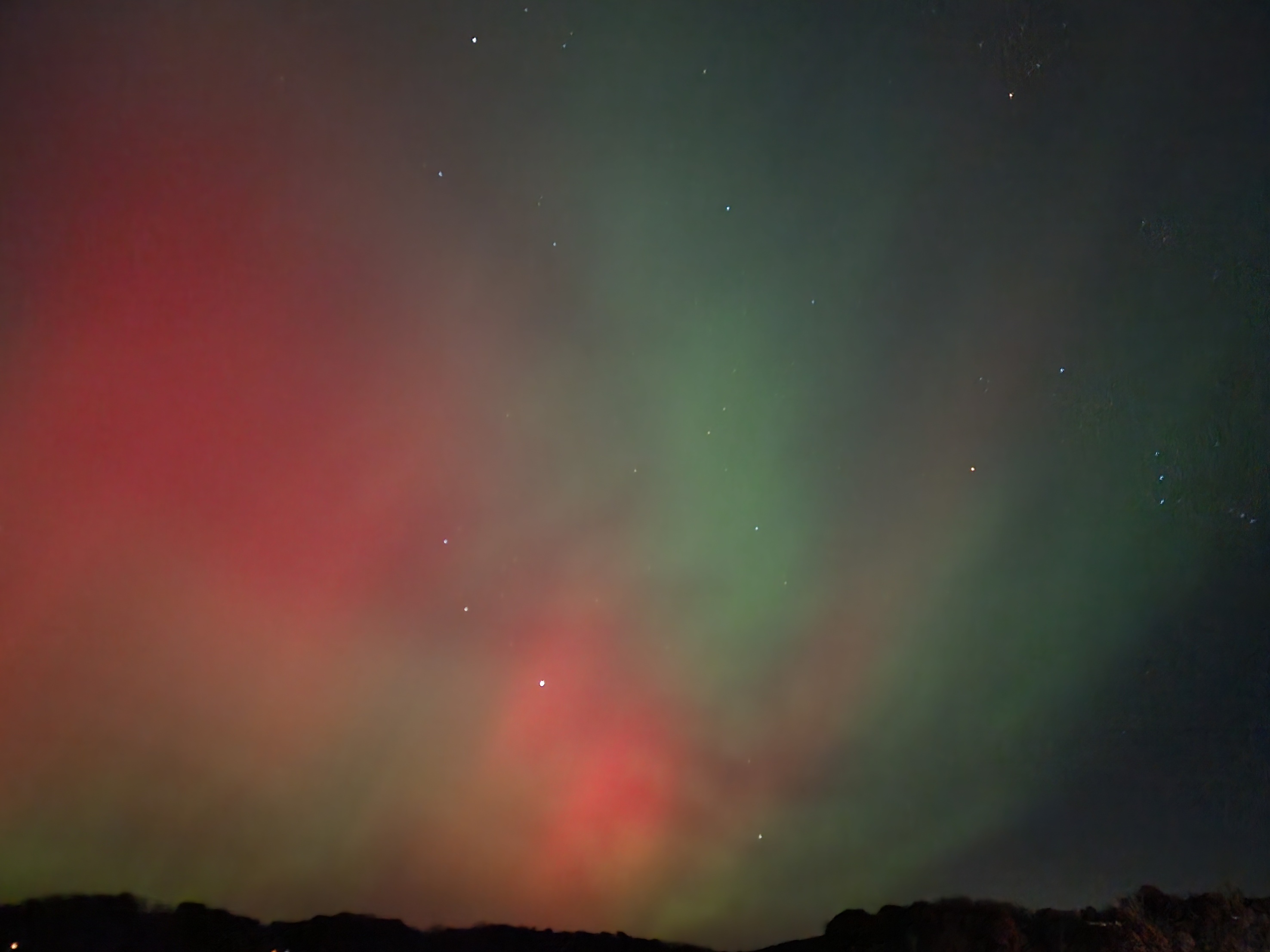
The solar storm that impacted Earth on Tuesday, November 11 (North American time) brought a display of northern and southern lights that dazzled onlookers in latitudes as far south as Texas and Arizona. In eastern Iowa, we were lucky to get completely clear skies and an auroral show that started early enough in the evening that many locals were able to watch and document the sky. See our gallery below of dynamic photos and videos taken by colleagues associated with the Physics & Astronomy department here at the University of Iowa!
When the sky lights up
Auroras are sparked by increases in energy transferred from the solar wind to inside the Earth’s magnetic shield (the magnetosphere). They happen nightly at high latitudes, but when the Sun sends off a big blob of material and conditions that couple the energy transfer to Earth are favorable, we see an expansion of the auroral oval that can reach to very low geographic latitudes and surprise sky watchers with their sudden appearance. This energy transfer is difficult to predict or quantify. This is one aspect that auroral and space environment researchers are still researching. We did have forewarning of a set of large CMEs (coronal mass ejections) that left the Sun and were heading towards Earth. But the exact magnitude of the effects on Earth are often a gamble.
The peak of solar activity
The most intense geomagnetic storms of the last 10 years have occurred since May 2024 (known as “the Gannon storm”). The Sun is currently just past the peak of its active phase, measured by sunspot number, which oscillates on roughly an 11-year period. During its maximum activity level, known as solar maximum, and past that point into the declining phase is when we get most of the larger and most geoeffective solar storms. The previous solar maximum, which occurred in 2014, was an atypically weak solar maximum - so we didn’t get these low latitude auroras in the last cycle like we are seeing now.
Measuring the pulse of a geomagnetic storm
The strength of a given storm depends on indices that use ground-based measurements to assess the intensity of various parameters in the space environment. The Disturbance Storm Time index (or Dst index) is a common metric by which we compare strong events. The technique uses an array of ground-based magnetometers to measure the changes in fields and currents occurring out in space around Earth. The November 11 event recorded a provisional Dst value of -238 nT - an indication of intense changes in geospace! By comparison, the Gannon storm of May, 2024 plummeted down to -406 nT. Another way we compare solar storms is by the direction of the solar magnetic field as it encounters the region near Earth. The Earth’s field points northward; when the Sun’s magnetic field approaches Earth in a southward direction, it allows for the fields to “reconnect” together and funnel a large amount of energy inside of Earth’s magnetosphere. The solar wind southward (z direction) value reached nearly -50 nT and stayed southward for almost 2 hours continuously, allowing for a huge transfer of energy.
A captivating light show
Observers of the November 11 event reported a large amount of red emission - similar to what was seen during the Gannon storm. Red auroras usually indicate lower energy particles that collide with higher layers of our atmosphere, meaning that they can be seen at longer distances and so are often the horizon glow observed at more equatorward locations. Photos and videos posted online have also shown seemingly discontinuous, small patches of green that show up within the red aurora and disappear just as quickly. The auroras captured at lower latitudes were exceptionally dynamic throughout the night. Some optical recordings even caught pulsating aurora - a type of aurora that contains very high energy particles and (paradoxically) is often sub-visual. If you think you saw some faint, oscillating patches of aurora the other night, you may have seen this kind of aurora, which is rare to see in the state of Iowa! Whatever you saw (or missed) - it was an incredible night for all who have curiosity about the natural world around them.